- Home
- Moroccan Argan Oil: The Story Behind Morocco’s Golden Treasure
- 29 October 2025
- 102 Views
- General
- ArganOil, EcoHeritage, MoroccanTradition, SustainableBeauty,
Moroccan argan oil appears in hair treatments, moisturisers and luxury cosmetics around the world. Yet its story begins far from modern beauty counters, in the dry landscapes of southwestern Morocco.
The oil comes from kernels hidden inside the fruit of the argan tree. For generations, local communities have used the tree for food, oil, animal feed and everyday materials.
Argan oil is therefore much more than a beauty product. It connects Morocco’s natural environment with Amazigh knowledge, rural livelihoods and traditional food culture.
Moroccan Argan Oil at a Glance
| Detail | What to Know |
|---|---|
| Source | Kernels inside the fruit of the argan tree |
| Main Region | Southwestern Morocco |
| Culinary Oil | Usually made from lightly roasted kernels |
| Cosmetic Oil | Usually made from unroasted kernels |
| Common Uses | Cooking, skincare and haircare |
| Cultural Connection | Amazigh knowledge and rural production |
| Buying Priority | Intended use, ingredients and traceability |
| Important Warning | Only consume oil clearly labelled for food use |
Where Does Moroccan Argan Oil Come From?
The argan tree grows mainly in the arid and semi-arid landscapes of southwestern Morocco, between the Atlas Mountains and the Atlantic coast.
Its ability to survive dry conditions makes it an important part of the region’s environment and rural economy. The wider argan landscape, known as the Arganeraie, supports biodiversity, farming and local communities.
Knowledge connected with the tree includes collecting its fruit, cracking the nuts, extracting the oil and preparing traditional recipes. These practices have been passed between generations, particularly within Amazigh communities.
How Is Argan Oil Made?
Argan oil production requires several stages.
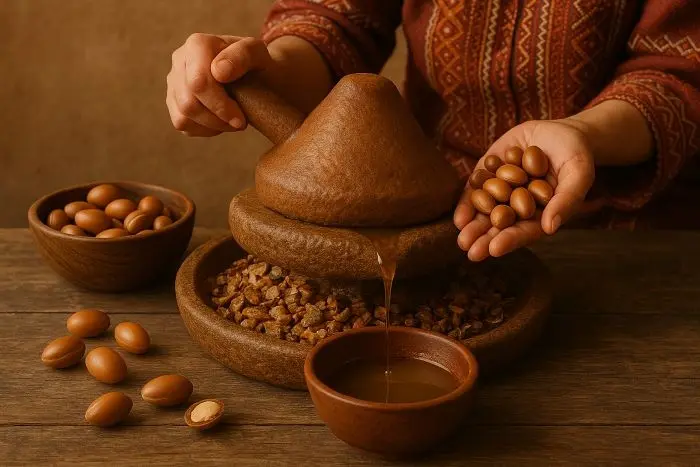
Mature fruits are collected and dried before the outer pulp is removed. Inside each fruit is a hard nut containing small, oil-rich kernels.
The shell must be cracked carefully without damaging the kernels. They are then prepared according to the intended use of the oil.
For culinary oil, the kernels are usually roasted. For cosmetic oil, they are generally left unroasted. The kernels are then pressed, and the extracted oil is filtered or left to settle before bottling.
Modern equipment can make pressing faster, but collecting, preparing and cracking the fruit may still involve considerable manual work.
Culinary vs. Cosmetic Argan Oil
Both oils come from the same tree, but their preparation and intended uses are different.
Culinary Argan Oil
Culinary argan oil is generally made from lightly roasted kernels. Roasting gives it a deeper golden colour and a rich, nutty flavour.
Moroccans serve it with bread or use it as a finishing oil for salads, couscous and vegetables. It is also a key ingredient in amlou, a traditional spread made with almonds and honey.
Cosmetic Argan Oil
Cosmetic argan oil is usually produced from unroasted kernels. It tends to have a lighter colour and a milder aroma.
People use it to soften dry skin, condition hair and care for nails or beards. It may be sold as pure oil or added to shampoos, creams and serums.
Can Cosmetic Argan Oil Be Eaten?
Do not consume a product simply because its label says “pure argan oil.”
Cosmetic oil is produced for external use and may not meet food-safety standards. For cooking or tasting, choose a sealed bottle clearly labelled as food-grade, edible or culinary argan oil.
What Does Argan Oil Do for Skin and Hair?
Argan oil contains mainly unsaturated fatty acids, including oleic and linoleic acids.
When applied to the skin, it works mainly as an emollient, helping dry areas feel softer. On hair, it may improve smoothness, shine and manageability.
The result depends on the product and the amount of argan oil it contains. A bottle of pure oil will behave differently from a shampoo in which argan oil appears near the end of the ingredient list.
Argan oil should not be treated as a medical cure. Claims that it can reverse ageing, permanently regrow hair or treat serious skin conditions go beyond what a cosmetic oil can reliably promise.
Is Culinary Argan Oil Healthy?
Food-grade argan oil contains unsaturated fats and naturally occurring antioxidant compounds.
Some studies have examined its possible effects on cholesterol and other blood-lipid measurements, but the available research remains limited.
Argan oil can form part of a balanced diet, especially when used as a flavourful finishing oil. However, it is not a treatment for high cholesterol or heart disease. Like all edible oils, it is also calorie-dense.
What Is Amlou?
Amlou is one of the best-known culinary uses of Moroccan argan oil.
This traditional spread usually combines roasted almonds, honey and food-grade argan oil. It has a smooth texture and a sweet, nutty flavour.
Amlou is commonly served with Moroccan bread, msemen, baghrir or pastries. Recipes vary between families, with some versions containing more honey and others emphasising the flavour of almonds and argan oil.
Women and Morocco’s Argan Tradition
Women have long played an important role in preparing argan fruit, cracking nuts and producing oil.
These skills require patience and experience and have traditionally been passed from one generation to the next. Women-led cooperatives have also created training and income opportunities in several rural communities.
However, the word “cooperative” alone does not guarantee fair wages, authentic production or full traceability. Reliable sellers should provide clear information about where and how their oil was produced.
How Can You Identify Genuine Argan Oil?
There is no single colour, smell or texture test that proves authenticity. Genuine oil can vary depending on roasting, filtration, refinement and storage.
Instead, check the following details.
Read the Ingredients
Pure cosmetic argan oil should generally list one ingredient:
Argania Spinosa Kernel Oil
If perfume, silicone or other oils are included, the product is a blend rather than pure argan oil.
Confirm the Intended Use
Choose culinary oil for food and cosmetic oil for skin or hair. The label should state the intended purpose clearly.
Check the Producer
Look for:
- Producer or company name
- Country or region of origin
- Batch or lot number
- Bottle volume
- Expiry or best-before date
Words such as “natural,” “premium” and “traditional” do not prove authenticity on their own.
Examine the Packaging
A sealed bottle made from dark glass or another light-protective material can help preserve the oil.
Clear packaging does not automatically indicate a fake product, but oil stored in strong sunlight or excessive heat may lose quality more quickly.
Do Not Rely Only on Smell
Culinary argan oil usually has a stronger roasted aroma. Cosmetic oil is generally milder, while refined oil may have little scent.
A fragrance-free product is therefore not automatically fake or diluted.
Buying Argan Oil in Morocco
Argan oil is sold in cooperatives, pharmacies, specialist shops, supermarkets and traditional souks.
Before buying:
- Confirm whether the oil is culinary or cosmetic
- Read the full ingredient list
- Check the producer and origin
- Choose a sealed, clearly labelled container
- Compare prices between sellers
- Request a receipt
A very low price may indicate dilution or poor quality. However, a high price, sales demonstration or “cold-pressed” label does not guarantee authenticity either.
Ask where the oil was produced, whether the kernels were roasted and whether the product is pure or blended.
More Than a Beauty Trend
Moroccan argan oil connects a distinctive natural landscape with Amazigh knowledge, rural work and food culture.
Its value extends far beyond luxury cosmetics. Producing the oil requires time, careful preparation and specialist skill.
By choosing products according to their intended use, reading labels carefully and checking their origin, you can appreciate argan oil for what it truly is: a Moroccan treasure shaped by its landscape, communities and generations of knowledge.